
A thermostat that will not hold temperature, a heat pump that runs constantly, or an AC system that suddenly blows warm air can all look like simple problems from the outside. Often, they are not. The purpose of professional HVAC diagnostics is to identify the actual source of the failure before a repair is recommended. That matters when your comfort, energy costs, and equipment lifespan are on the line.
For homeowners and local businesses in Washougal, Vancouver, and throughout Clark County, a correct diagnosis can prevent repeat service calls, unnecessary part replacements, and the frustration of a system that works for a day and fails again when the weather changes.
What HVAC Diagnostics Actually Means
HVAC diagnostics is a structured inspection and testing process used to determine why a heating or cooling system is not operating as it should. It is more than noticing that a furnace will not start or that an air conditioner is not cooling. A technician traces the issue through the system's electrical controls, airflow, refrigerant circuit, combustion components, drainage, and mechanical parts.
Many HVAC symptoms have more than one possible cause. For example, weak airflow may come from a clogged filter, closed registers, damaged ductwork, a failing blower motor, a dirty indoor coil, or an incorrectly sized system. Replacing a blower motor without checking the rest of the system might not solve the problem.
A reliable diagnosis looks for both the immediate failure and the condition that may have contributed to it. If a capacitor has failed, the technician should also consider whether the outdoor fan motor, compressor, electrical connections, or system age put extra strain on that component.
Why a Proper Diagnosis Saves Money
The lowest-cost repair is not always the repair with the smallest invoice today. A quick part swap based on guesswork can lead to another breakdown, higher utility use, or damage to more expensive equipment. Accurate testing gives you a clearer answer about whether repair is reasonable or whether the system is reaching the point where replacement deserves consideration.
This is particularly important with heat pumps, which provide both heating and cooling for many Southwest Washington properties. A heat pump that struggles in winter may have an airflow issue, a defrost control problem, low refrigerant, an outdoor-unit fault, or an electrical issue. Those conditions can produce similar comfort complaints but require very different repairs.
Professional HVAC diagnostics also helps protect warranty coverage. Manufacturers may require proper troubleshooting and documented repair procedures, especially when major components such as compressors, control boards, or heat exchangers are involved.
What a Technician Checks During an HVAC Diagnostic Visit
The exact process depends on the equipment and the reported problem, but a thorough service visit starts with the basics: when the issue began, what the system is doing, whether it makes unusual sounds, and whether the problem occurs only in heating or cooling mode. Those details help narrow the inspection without replacing the testing process.
Thermostat and Electrical Controls
The thermostat is the command center, but it is not always the cause of a comfort problem. A technician checks thermostat settings, power, wiring, signals to the equipment, and any error codes. They may also inspect disconnects, breakers, fuses, contactors, capacitors, relays, transformers, and circuit boards.
Electrical problems can be intermittent. Loose wiring or a weakening component may allow a system to start sometimes while failing under load. Testing voltage and amperage helps identify components that may look normal during a visual inspection but are not performing correctly.
Airflow and Indoor Equipment
Comfort depends on moving the correct amount of air through the system. Restricted airflow can cause an AC coil to freeze, reduce heating output, increase operating costs, and place stress on the blower and compressor.
A diagnostic inspection may include the air filter, blower assembly, indoor coil, return-air path, supply registers, duct condition, and static pressure. A dirty filter is a common issue, but it is not the answer to every airflow complaint. If changing the filter does not restore normal performance, further testing is warranted.
For furnaces, the technician may also inspect the ignition system, flame sensor, burners, inducer motor, pressure switch, venting, safety controls, and heat exchanger. A furnace that shuts down repeatedly should not be ignored. Safety controls are designed to stop operation when the equipment detects unsafe or abnormal conditions.
Outdoor AC or Heat Pump Equipment
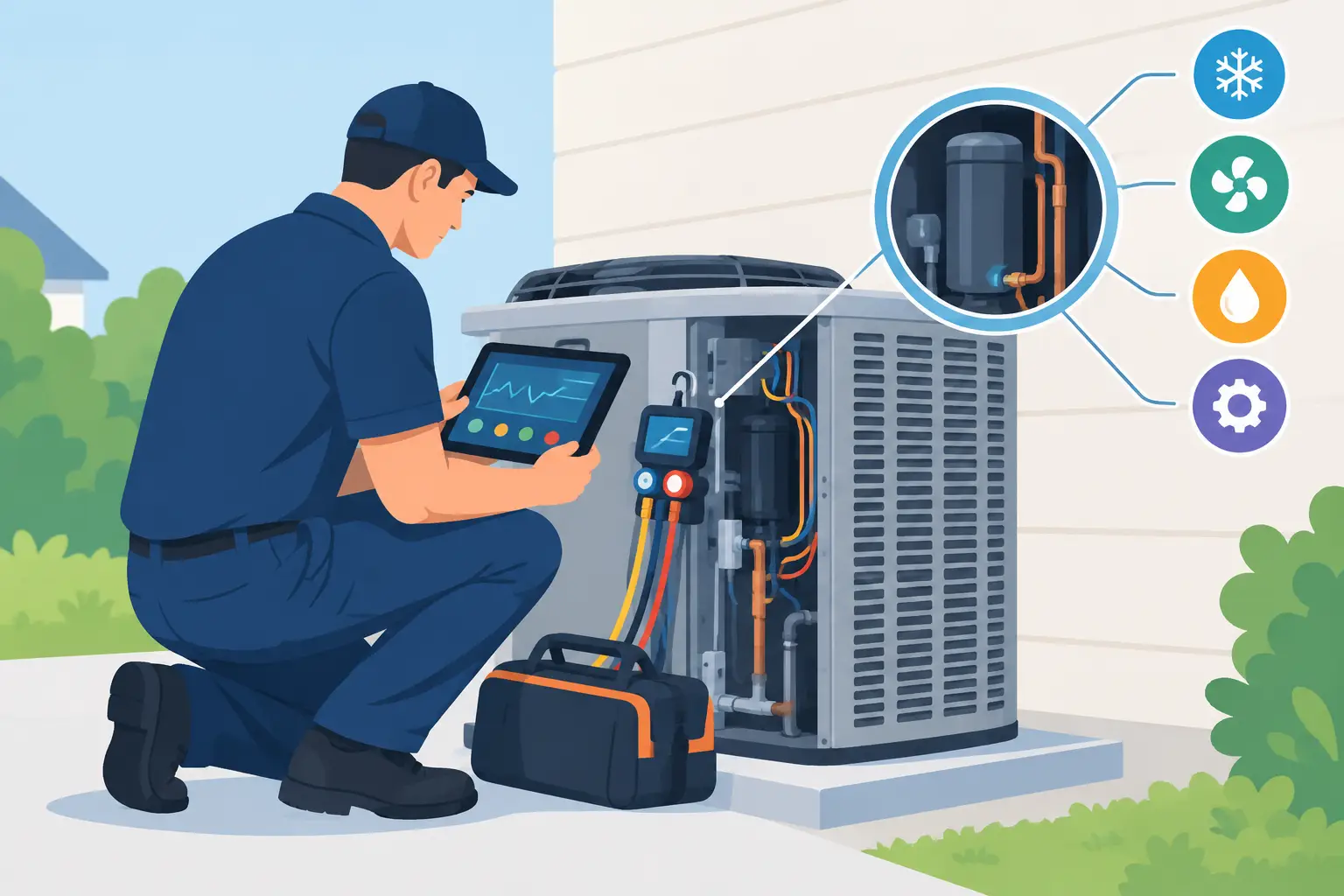
When diagnosing an air conditioner or heat pump, the outdoor unit requires more than a quick glance at the fan. The technician checks the condenser coil, fan motor, compressor operation, electrical components, refrigerant pressures, temperature readings, and overall performance in the active mode.
Refrigerant issues deserve careful attention. Low refrigerant is not a normal seasonal condition that simply needs a refill. In a properly sealed system, refrigerant should not be routinely consumed. If testing indicates a low charge, the technician should consider whether a leak is present and explain the repair options based on the equipment's condition.
Heat pumps also require attention to their reversing valve and defrost operation. During cold, wet Clark County weather, outdoor frost can be normal for short periods. Heavy ice buildup or a unit that does not complete a defrost cycle is not something to overlook.
Condensate Drainage and Moisture Issues
Air conditioners and heat pumps remove humidity during cooling operation. That moisture has to drain away safely. A clogged condensate line, damaged drain pan, or failing condensate pump can trigger shutdowns or cause water damage near indoor equipment.
This issue can be easy to miss until water appears around a furnace, air handler, or utility area. If you see water where it should not be, turn the system off if necessary to prevent further damage and arrange service promptly.
Signs You Should Schedule HVAC Diagnostics
Some problems are obvious, such as a system that will not turn on. Others are gradual. Calling for service before a complete failure can give you more control over repair timing and help avoid an emergency during a heat wave or cold spell.
Schedule an evaluation if your system shows several of these signs:
- It runs longer than usual but does not reach the thermostat setting.
- Airflow is weak, uneven, or noticeably different between rooms.
- Your utility bill rises without a clear change in weather or usage.
- The equipment cycles on and off frequently.
- You hear grinding, buzzing, rattling, or repeated clicking.
- The system produces unusual odors, moisture, or ice buildup.
- A furnace, AC unit, or heat pump needs repeated repairs for similar issues.
A burning smell, electrical odor, gas smell, visible smoke, or a carbon monoxide alarm requires immediate action. Leave the area if needed, follow emergency safety guidance, and do not continue operating the equipment until it has been evaluated.
Repair or Replacement: The Diagnostic Results Matter
An honest diagnostic visit should not treat every problem as a replacement opportunity. Many issues, including failed capacitors, worn contactors, ignition faults, clogged drains, thermostat problems, and some blower issues, can be repaired effectively when the equipment is otherwise in good condition.
Replacement may be worth discussing when a system is near or beyond its expected service life, has a major component failure, uses outdated refrigerant, or has a history of expensive repeat repairs. Efficiency, comfort needs, installation quality, and available budget all matter. A newer system with a repairable issue is usually evaluated differently than an older unit with a failing compressor and ongoing performance problems.
For property managers and small business operators, downtime is another factor. The right decision may depend on whether a repair can reliably carry the equipment through the season or whether planned replacement will reduce disruption for tenants, employees, or customers.
What You Can Check Before Service
There are a few safe checks that can help rule out simple issues. Confirm the thermostat is set to the correct mode and temperature, make sure breakers have not tripped, and replace a visibly dirty filter with the correct size and type. Check that supply registers and return vents are not blocked by furniture or stored items.
Do not remove electrical panels, add refrigerant, bypass safety switches, or continue resetting a breaker that trips repeatedly. Those steps can create safety risks and make an underlying equipment problem worse.
When you call for service, share what you observed: when the problem started, whether it affects heating, cooling, or both, any sounds or error codes, and whether the system has received recent repairs. That information helps the technician begin with the right questions.
Creekside HVAC provides expert heating and cooling services for homeowners and local businesses across Washougal, Vancouver, and Clark County. A clear diagnosis gives you the information needed to choose the next step with confidence, whether that means a targeted repair, a maintenance correction, or a conversation about new equipment. If your system is asking for attention, addressing it early can help protect your comfort before a small issue becomes a no-heat or no-cooling call.